United States and China Eye 30 Billion Dollar Tariff Cut Deal Ahead of Trump-Xi Beijing Summit
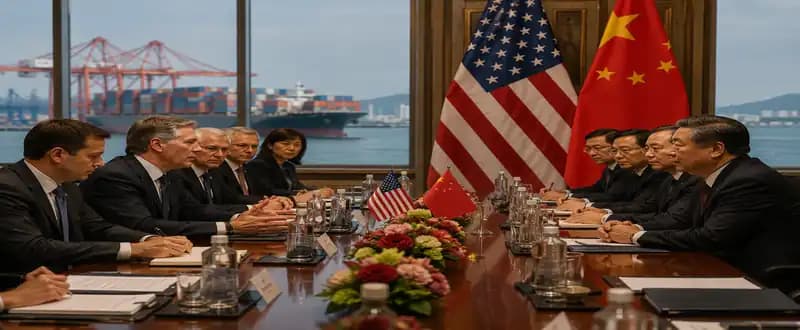
- U.S. and China to identify roughly thirty billion dollars of goods each for reciprocal tariff cuts
- Board of Trade mechanism marks shift away from demands for Chinese economic model reform
- Court of International Trade invalidated Section 122 tariffs in 7 May ruling
- Customs and Border Protection activated IEEPA tariff refund process on 20 April
- More than sixty Section 301 investigations launched targeting excess capacity and forced labour
The United States and China are preparing to advance a managed trade arrangement covering roughly thirty billion dollars in non-sensitive imports each, with both sides expected to identify product categories eligible for reciprocal tariff reductions during this week's summit in Beijing. Reuters reported on 13 May that the proposal, described internally as a Board of Trade mechanism, was first raised by U.S. Trade Representative Jamieson Greer in March and has been positioned as a key deliverable for the meeting between President Donald Trump and President Xi Jinping.
The specifics of the proposed arrangement remain under discussion, though the broad outlines mark a notable shift from previous trade dialogues. Washington has stepped back from earlier demands that Beijing dismantle its state-directed, export-driven economic model. Instead, the focus is on carving out specific goods that can be traded with lower duties without crossing the national security boundaries that have shaped the past three years of bilateral commerce.
The summit comes at a moment of heightened uncertainty for cross-border supply chains. Average effective U.S. tariff rates have climbed substantially over the past year, and recent court actions have added further volatility. The Court of International Trade ruled on 7 May that 10 percent tariffs imposed under Section 122 by presidential proclamation were invalid, while a separate refund process for duties paid under the International Emergency Economic Powers Act was activated by Customs and Border Protection on 20 April. President Trump's April 2 proclamations also reset duties on certain pharmaceuticals and adjusted Section 232 tariffs on aluminium, copper and steel.
Tariff discussions are running alongside parallel U.S. policy actions targeting structural excess capacity and forced labour concerns, with the Office of the U.S. Trade Representative having initiated more than sixty Section 301 investigations in March. The administration has continued to use Section 232 authority for what it has framed as supply chain sovereignty objectives, with active investigations covering semiconductors, robotics, polysilicon and pharmaceuticals.
For importers and procurement teams, the prospect of a defined list of tariff-reduced categories carries direct implications for landed costs, sourcing decisions and contract negotiations. Buyers with significant China exposure are likely to delay long-tenor commitments until the outcome of the summit is clearer, while indexed clauses tied to duty rates are expected to come under fresh scrutiny. The temporary nature of the current 10 percent global tariff, which is set to expire in mid-summer absent congressional action, adds further pressure to procurement planning cycles for the second half of the year.
Recent News & Articles

Methyl Vinyl Ether Buyers Review Regulatory Fit Before Supplier Approval

Feed Barley Procurement Tightens as Australian Output Is Expected to Drop

Diethyl Sulfate Procurement Requires Hazardous Substance Cost Checks

Castor Oil Procurement Needs Quality Review Before June Contracts
Zinc Sulfate Procurement Tightens as Zinc Rally Raises Supplier Offers
Tags
- Access independent price trends and market intelligence for thousands of raw materials.
- Request customised production cost and prefeasibility reports for specific plants or locations.
- Explore subscription dashboards for continuous tracking of prices, indices, and news.
- Commission bespoke research on categories, suppliers, or trade flows tailored to your brief.
Our Team will be happy to assist you
We are Just a Text away